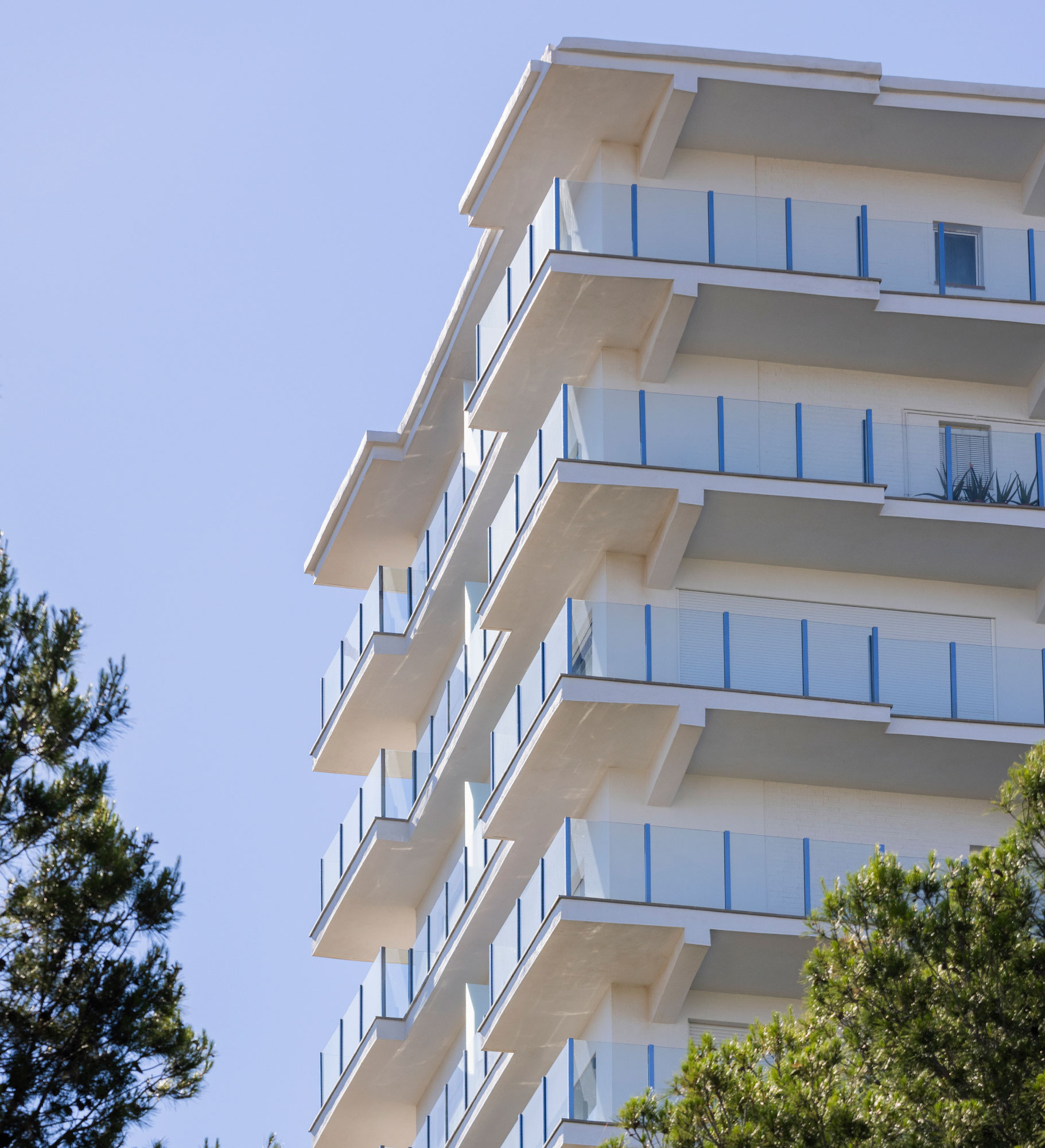
Wind loads are a factor that must be taken into account when designing glass railings installed outdoors, in accordance with the requirements of the Spanish Technical Building Code (CTE).
Therefore, when a railing system is installed outdoors or inside buildings with large openings, it is essential to assess the effects of wind loads on the structure and verify compliance with all safety requirements established by current regulations.
The CTE explicitly addresses wind loads on glass railings. Consequently, overlooking this factor and limiting structural verification solely to the horizontal loads associated with the relevant occupancy category may result in non-compliance with regulatory requirements. It can also lead to inadequate structural design and insufficient railing strength for the actual conditions of the project, putting user safety at risk.
Mandatory consideration of wind loads on glass railings
The Basic Document DB SE-AE, Actions on Structures, of the Spanish Technical Building Code (CTE), addresses wind action in Section 3, which covers variable actions, with specific provisions set out in Section 3.3. This section establishes that, for the local analysis of façade and building envelope elements, such as window and door frames and glazing, wind action must be determined from the resultant pressures acting at each point, applying the wind pressure coefficients defined in Annex D.3.
The regulations therefore require wind action to be assessed according to the specific exposure conditions of each project and the corresponding wind pressure coefficients. This requirement directly affects glass railings installed outdoors, as the glass forms a surface exposed to wind loads. The resulting pressures must be taken into account when calculating and dimensioning the railing system.
What factors influence wind loads on glass railings?
Wind action cannot be determined using a single value applicable to all glass railings. The specific conditions of each project directly influence the loads to which the system may be subjected.
As explained in the previous section, Section 3.3 of the Basic Document DB SE-AE, Actions on Structures, which addresses wind action, refers to the wind pressure coefficients established in Annex D.3. Applying these coefficients requires consideration of several interrelated factors, including:
- The geographical location of the building determines the basic wind speed used as a reference for calculations. This value varies according to the wind zone in which the project is located and is one of the starting points for determining the wind loads that the railing must withstand.
- The terrain roughness and topography influence the building's exposure to wind. Obstacles, nearby buildings and specific terrain characteristics can affect how wind acts on the structure. Consequently, a building in a densely developed urban area will experience different exposure conditions from one located in an open or particularly exposed environment.
- The installation height and position of the railing within the building influence the wind pressure and/or suction acting on the system. Wind action can vary significantly between different heights and areas of the same building, making it essential to consider the precise location of each railing section during the analysis.
- The effective area of the exposed surface determines how wind forces are distributed across the railing. The surface area considered in the calculations affects the loads the system must withstand and is particularly relevant for configurations comprising multiple glass panels or sections with larger exposed surfaces.
Consequently, considering wind action when calculating outdoor glass railings is essential and a mandatory regulatory requirement.es. Solo mediante una evaluación adecuada de estos factores es posible garantizar que el sistema cumple las exigencias de seguridad establecidas en la normativa vigente.
Horizontal loads and wind action: why a single verification is not enough
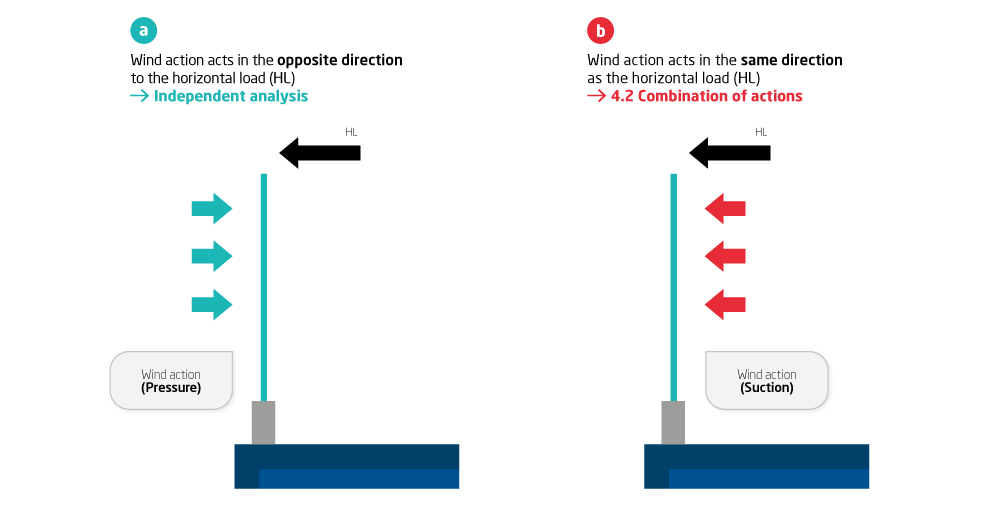
The structural verification of a glass railing must not be limited solely to the horizontal load associated with its occupancy category. For outdoor installations, since these loads are classified as variable actions, regulations require railings to undergo an ultimate limit state verification of resistance. Therefore, the partial safety factor of 1.5 for variable actions, specified in Table 4.1 of the CTE DB-SE Structural Safety document, must be applied.
When wind action acts in the same direction as the horizontal force applied to the railing, as occurs under wind suction conditions, both actions must be considered together when verifying structural resistance. In this case, the partial safety factor of 1.5 is applied to the variable actions and, additionally, a combination factor of 0.6 is applied to the wind action, in accordance with Table 4.2 of DB-SE, which establishes the combination factors for variable actions.
Consequently, a glass railing may meet the resistance requirements for the horizontal load corresponding to its occupancy category yet fail to satisfy the requirements when the combined effects of wind action are taken into account. This highlights the importance of considering both actions when calculating and dimensioning the system to ensure structural safety and compliance with current regulations.
The impact of wind loads can be particularly significant in highly exposed projects, such as installations at considerable heights, in open areas or near the coast, where wind action may become a determining factor in the structural design of the railing system.
Calculate wind loads on your glass railing with our online technical support service
At Comenza, our team of designers and engineers in the R&D&I department develops solutions that make all our railing systems quick and easy to install, while ensuring strict compliance with current regulations. This gives professionals confidence and helps guarantee user safety. Our Technical Office supports professionals throughout their projects, providing solutions tailored to the specific needs and requirements of each project, including wind load analysis where necessary.
If you are working on a project and need free, specialised assistance with wind load calculations, you can schedule an online meeting with our team through our Online Technical Support service.